
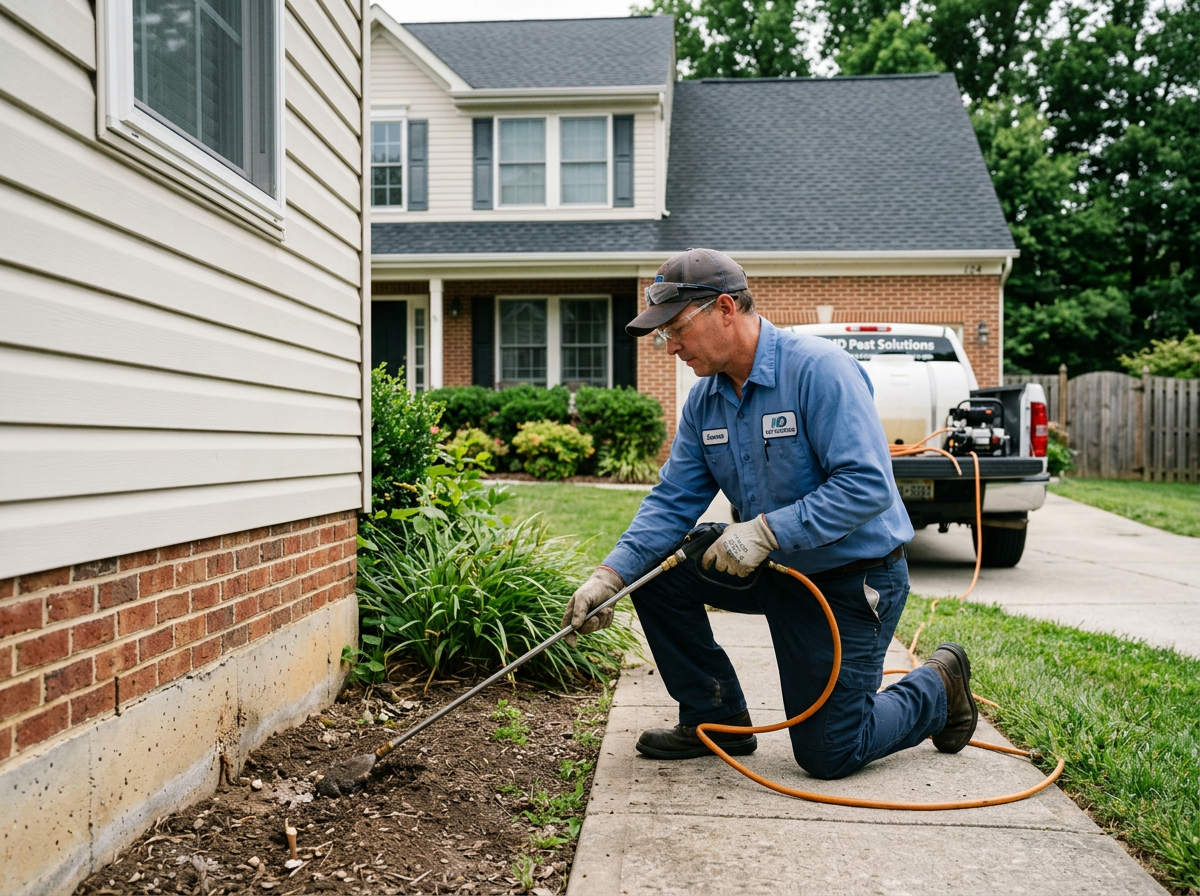
Kennedyville farmhouses along MD-213 feature mixed-era construction that leaves wood-to-soil contact at multiple points. Crews work around active grain fields and outbuildings when treating these sites.
Hot summers keep termite colonies moving through the mild winters typical of Kent County, so inspections cover both the main house and any detached barns or sheds on the parcel.
Here's how our termite treatment work runs in Kennedyville — the same standards we hold across Maryland, delivered by the crew that covers Kent County.
Termite Treatment Services We Offer in Kennedyville
✓Liquid Soil Barrier Treatment
Creates a continuous treated soil zone around and beneath the structure to block foraging workers from reaching wood members.
✓Trenching and Rodding
Excavates perimeter trenches and rods termiticide beneath slabs, porches, and additions where excavation alone cannot reach.
✓Slab and Addition Treatment
Applies termiticide through drilled access points and along expansion joints of concrete slabs and later home additions.
✓Crawl Space and Pier Treatment
Treats soil at pier bases, sill plates, and grade beams in elevated structures common to Eastern Shore watermen's homes.
✓Spot Treatment for Localised Activity
Applies targeted termiticide to visible mud tubes and nearby soil when full perimeter work is scheduled later.
Eastern subterranean termites dominate Maryland properties, especially on the Eastern Shore where high water tables and pier-supported homes create constant wood-to-soil contact. Technicians identify active colonies through mud tubes along foundation walls, piers, and joists rather than relying on swarmers alone, which homeowners often mistake for flying ants. A proper treatment establishes an unbroken chemical zone in the soil around and under the structure so foraging workers cannot reach the wood above. Gaps left near additions, utility entries, or previous repairs allow the colony to bypass the barrier and re-enter within months.
Liquid soil barrier work begins with trenching along the exterior perimeter and rodding under slabs and porches to place termiticide at label depth. In crawl spaces, treatment extends to piers, sill plates, and any grade beams where soil contact occurs. Bait stations offer an alternative when excavation would disturb landscaping or when the structure sits too close to wells or drainage features. Neither method reaches every forager instantly because the colony may extend sixty feet or more from the visible tubes, so follow-up inspections confirm whether activity has ceased or shifted to untreated soil.
How It Works in Kennedyville
- 1
Initial Site Assessment
Technician inspects crawl space, basement, foundation exterior, and any additions for active tubes, moisture sources, and conducive conditions.
- 2
Treatment Plan Selection
Liquid barrier or bait system is chosen based on soil access, water table, and proximity to wells or landscaping.
- 3
Application
Trenching, rodding, or station placement establishes the treated zone around the entire structure and under slabs.
- 4
Follow-Up Monitoring
Return visits check for new activity and confirm the barrier or bait stations remain effective.
Serving All of Kennedyville
We regularly handle termite treatment jobs near:
- 📍MD-213 corridor
- 📍Kennedyville grain farms
- 📍Kent County agricultural outbuildings
- 📍Eastern Shore farm roads
Termite Treatment Pricing in Kennedyville
Scope depends on foundation type, additions, crawl-space access, and whether a full barrier or bait system is selected. Call for an on-site inspection and quote.
Want the full picture of this service? See our Termite Treatment page, or everything we do in Kennedyville, MD.